


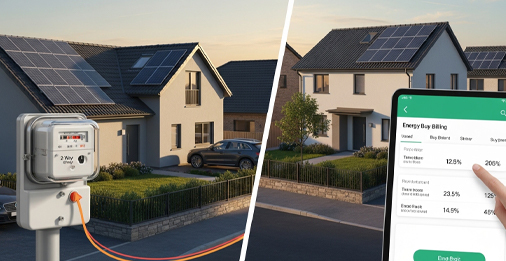
Solar energy adoption is rising quickly, and many homeowners now ask one important question before installing panels: net billing vs net metering, what actually changes in your monthly savings? The answer matters because the way your extra solar electricity is credited can shape your return over time.
Understanding the difference between net metering and net billing helps you plan smarter, especially if you want predictable energy costs. Feroze Power works with solar customers who want clarity on these systems before committing to an installation.
What Net Metering Means
Net metering is a billing system in which your solar panels send any unused electricity back to the grid. Your utility company then gives you credits for the energy you exported.
These credits offset the electricity you import later, such as at night or during cloudy days. The key benefit is that the exported power is often credited at a rate close to what you pay for electricity.
People comparing net metering vs net billing often notice that net metering feels more straightforward because the unit exported and imported is treated almost equally in many cases.
Net metering is usually attractive for households that produce significant surplus power during the day.
A useful way to think about it: your meter runs backward when you export energy.
What Net Billing Means
Net billing works differently. You still export excess electricity to the grid, but the credit you receive is usually lower than your retail electricity price.
Instead of a one-to-one offset, utilities pay you at a separate export rate, which may be closer to the wholesale cost of electricity.
This is why the debate around net billing vs net metering is important. Under net billing, self-consumption becomes more valuable. Using your solar energy directly during the day saves more than exporting it.
Many homeowners under net billing choose to add batteries later, since storing solar energy can be more profitable than selling it back cheaply.
Where the Difference Really Shows Up
The real difference comes down to the value of your exported electricity.
With net metering:
- Export credits are usually higher
- Surplus power offsets future usage more strongly
- Payback periods can be shorter
With net billing:
- Export credits are lower
- Using power directly matters more
- Batteries become more attractive
When customers ask Feroze Power about the difference between net metering and net billing, the first step is understanding daily consumption habits. A home that uses most electricity in the evening may experience different outcomes depending on the billing structure.
You can also review the latest net metering policy updates through local energy authorities before deciding.
Net Billing vs Net Metering in Pakistan
In Pakistan, solar adoption has accelerated due to rising electricity prices and frequent load-shedding. That’s why searches for net metering vs net billing in Pakistan have increased so much recently.
Net metering has been widely used in Pakistan, allowing homeowners to export excess solar power and reduce their bills significantly.
However, discussions around shifting toward net billing models have raised questions about future credit rates and solar profitability.
For households investing today, it’s important to understand what system applies in your region and what regulatory changes may affect export compensation.
Feroze Power helps clients evaluate solar setups with long-term policy shifts in mind, so savings projections stay realistic.
Net Billing vs Net Metering
Feature | Net Metering | Net Billing |
Export Credit Rate | Often close to the retail rate | Usually lower than the retail rate |
Best For | High surplus solar producers | High self-consumption households |
Meter Behavior | Credits offset imports strongly | Credits are applied at a separate rate |
Battery Value | Optional | Often more useful |
Savings Predictability | Higher in many cases | Depends heavily on the export rate |
This table highlights why the difference between net metering and net billing matters for long-term planning.
What About Gross Metering?
Some customers also hear about gross metering, especially in comparisons like net metering vs gross metering vs net billing.
Gross metering is different from both systems. Instead of consuming solar energy directly, all solar production is sent to the grid, and the home buys electricity separately.
That structure is less common for residential users because it reduces direct savings from self-consumption.
Most homeowners prefer systems where they can use their solar energy first, then export what remains.
Which System Fits Your Solar Goals?
Choosing between net billing and net metering depends on three things:
Your Daily Energy Use
If your household uses most electricity during the daytime, net billing may still work well because you consume solar power directly.
If usage peaks at night, net metering often provides stronger bill reduction because exported credits offset later imports.
Export Credit Rates
The financial outcome depends heavily on what your utility pays for exported electricity.
This is why many installers say net metering can make your solar panels more profitable, especially when export rates remain favorable.
Long-Term Planning
Solar is a 15–25 year investment. Policy adjustments, electricity tariffs, and future battery pricing all influence what makes sense.
Feroze Power often recommends building flexibility into your system design, so you can adapt if billing rules shift.
Conclusion
Understanding net billing vs net metering is one of the most important steps before installing solar. The difference is not about panels or hardware, but about how your extra electricity is valued once it reaches the grid.
Net metering often benefits homes with high surplus exports, while net billing rewards households that use more solar power directly. Knowing the difference between net metering and net billing helps you choose a system that matches your consumption and long-term savings goals.
If you’re planning solar and want clear guidance on the best approach, Feroze Power can help you evaluate your options and build a setup that supports real, lasting savings. Visit the Feroze Power homepage to get started with a consultation.
Faqs
1. What is the main difference between net metering and net billing?
The difference between net metering and net billing comes down to how exported solar electricity is credited. Net metering usually offsets your bill at a higher rate, while net billing pays a lower export rate.
2. Which is better: net billing vs net metering for solar savings?
For many homeowners, net billing vs net metering depends on usage patterns. Net metering often benefits homes that export more surplus power, while net billing works better when most solar energy is used directly.
3. How does net metering vs net billing work in Pakistan?
In Pakistan, net metering vs net billing is an important topic because policies and export credit rates can affect long-term savings. Checking the latest regulations helps solar buyers plan more accurately.
4. What is the difference between net metering, gross metering, and net billing?
When comparing net metering vs gross metering vs net billing, net metering allows credits that offset imports, net billing provides separate export payments, and gross metering sends all solar power to the grid while the home buys electricity separately.