


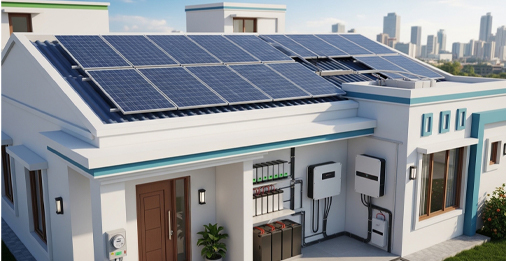
The numbers tell the story clearly. Solar imports in Pakistan collectively produced below 1GW in 2018. In early 2026, this grew to a staggering 51GW, making Pakistan one of the fastest-growing solar markets globally. Rising tariffs, persistent load shedding, and falling solar panel prices have pushed millions of Pakistani households and businesses toward renewable energy. Among the available options, on-grid solar systems have emerged as the most cost-effective starting point for urban homes and commercial users who want meaningful electricity savings without the full expense of battery backup. This guide covers exactly how on-grid solar systems work, how they compare to off-grid alternatives, what net metering changes mean for your investment in 2026, and how to decide which system is right for your situation.
What are On-Grid Solar Systems?
An on-grid system, also called a grid-connected solar system, links your solar panels directly to the national electricity grid. It is the most commonly used solar system for residential and commercial requirements. Unlike off-grid setups that operate independently with battery storage, an on-grid system partners with the grid, using solar power when available and drawing from the grid when solar generation is insufficient. An on-grid solar system allows your solar panels to supply electricity to your home or business, while excess energy can be exported back to the grid through net metering.
However, on-grid solar systems will not operate in case of an outage. If the utility is facing a power failure, the on-grid system will automatically stop. This makes an on-grid system unsuitable for places that experience frequent supply interruptions.
The result is a system that significantly reduces your electricity bill, requires no batteries, and pays for itself through both direct consumption of free solar power and credits earned by exporting surplus electricity. For Pakistani houses and businesses with reliable grid access, on-grid solar systems are the best option available.
What Are the Components of On-Grid Solar Systems?
On-grid solar systems consist of different components that work together to capture sunlight and provide sufficient solar energy to power our homes.
- Solar panels: Convert sunlight into DC electricity. Choosing the best solar panels in Pakistan will improve overall system output.
- Grid-tied inverter: Converts DC to AC electricity, synchronizing with the grid.
- Mounting structure: Secures solar panels to the roof or ground.
- Balance of system (BOS): Includes DC and AC cables, junction boxes, and safety equipment such as earthing systems and surge protectors.
- AC distribution board: Protects household circuits from AC overloads.
- Earthing system: Grounds all metal components for safety.
- Bi-directional meter: Measures both energy imported from and exported to the grid.
How On-Grid Solar Systems Work
Now let’s break down the different components of on-grid solar systems we mentioned earlier, work together, and how a solar on-grid system works.
1. Solar Power Generation
Solar panels absorb sunlight during the daytime and generate DC electricity. However, this energy cannot be used directly by most appliances as they run on AC power.
2. DC to AC Conversion
An inverter is needed to convert the direct current (DC) electricity generated by solar panels into alternating current (AC) electricity. The on-grid inverter takes the DC output from the solar panels and converts it into AC power that can be used by our appliances.
3. Powering the Load
The converted AC power is first used to run your household or office appliances. If your solar system generates more power than required, the excess energy is sent to the grid via a net meter.
4. Net Metering Process
The net meter keeps a record of how much electricity you consume from the grid and how much you supply back. At the end of every billing cycle, the net value is calculated, and you are billed only for the difference through a process called net metering.
5. Grid Backup Supply
At night or during cloudy days, when your solar panels don’t produce enough energy, the inverter supplies electricity from the grid to make sure an uninterrupted power supply.
Final Note: Standard on-grid solar systems shut down automatically during grid outages. This is a safety requirement to protect utility workers. If backup power during load shedding is a priority, a hybrid solar system with Battery Energy Storage Systems (BESS) is the more appropriate solution.
On-Grid vs Off-Grid vs Hybrid: Full Comparison Table
The choice between on-grid vs off-grid solar systems is one of the most important decisions any Pakistani solar buyer makes. Both serve different needs and come with different cost profiles.
Feature | On Grid | Off Grid | Hybrid |
Grid Connection | Yes | No | Yes |
Battery Required | No | Yes | Yes |
Works During Load Shedding | No | Yes | Yes |
Net Metering Eligible | Yes | No | Yes |
Upfront Cost | Lowest | Highest | Medium to High |
Best For | Urban homes and businesses | Remote areas | Urban homes needing backup |
Maintenance Complexity | Low | High | Medium |
Energy Independence | Partial | Full | Partial to Full |
What are the Benefits of On-Grid Solar Systems in Pakistan?
1. Lower Upfront Cost
On-grid solar systems tend to be cheaper on an upfront basis, as batteries for storage are not required. This makes them accessible to a wider range of Pakistani homeowners and businesses who want to begin generating solar returns without committing to the full cost of a hybrid system.
2. Bill Reduction
An on-grid solar system saves you a great amount on electricity bills, or sometimes zeros them completely during the sunny months. With Pakistan’s current tariff rates, a well-sized on-grid system typically delivers payback within 3 to 5 years.
3. Net Metering
Many countries, including Pakistan, provide a net metering option. Net metering is a billing arrangement that allows owners of solar energy systems to receive credit for the electricity they generate and send back to the grid. When your solar system generates more energy than you consume, it is fed back to the utility company through a bidirectional meter.
4. Low Maintenance
On-grid-Solar panels require minimal maintenance. Dust buildup can reduce output, which is why solar panel cleaning services are important. Routine Operations and Maintenance from a reliable company such as Feroze Power involves solar panel cleaning, inverter monitoring, and annual electrical inspections.
5. Clean Energy
Using on-grid solar systems helps make a cleaner environment. Solar energy emits very low greenhouse gases. This makes these systems more environmentally friendly compared to using polluting fossil fuels as sources of electricity. Solar energy also helps you rely less on fossil fuels, cut carbon emissions, and preserve the environment. It’s a great step toward a safer and healthier future. For businesses looking for sustainability credentials, on-grid solar also provides carbon credit eligibility, adding a financial dimension beyond simple bill savings.
Limitations to Be Aware Of
No Power During Grid Outages: This is the most significant limitation of standard on-grid solar systems in Pakistan. When the grid goes down, the system shuts off automatically. In areas with frequent or extended load shedding, this limits the practical benefit of the system during the hours when backup power is most needed.
Net Metering Policy Changes: Under the new Prosumer Regulations 2025, export rates are now calculated at a reduced rate of Rs 11.30 to Rs 13 per kWh while import rates remain at Rs 42 to Rs 48 per kWh. This creates a significant arbitrage gap favoring self-consumption over export. The economics of on-grid systems in 2026 reward homeowners who shift their major consumption to daytime hours rather than relying primarily on export credits.
Grid Dependence: An on-grid system’s usefulness is tied to grid reliability. In rural or semi-urban areas with unstable grid supply, the system’s performance and bill savings may be more variable than in cities.
Cost of On-Grid Solar Systems in Pakistan
The price of solar panels per watt has fallen from between 100 and 120 rupees in the early 2010s to about 30 rupees today. A home solar system of 3kW typically costs about 450,000 rupees, while larger commercial systems cost up to 2,200,000 rupees.
Here is a general cost reference for on-grid systems in Pakistan as of 2026:
System Size | Estimated Cost (PKR) | Suitable For |
3 kW | 380,000 to 500,000 | Small homes, 2 to 3 bedrooms |
5 kW | 550,000 to 750,000 | Medium homes, small offices |
10 kW | 950,000 to 1,300,000 | Large homes, commercial units |
20 kW+ | 1,800,000 and above | Industrial and commercial |
Prices vary based on panel brand, inverter quality, mounting structure, installation complexity, and distributor margins. Always obtain multiple quotes and verify that your installer is AEDB-certified for net metering approval.
Conclusion
On-grid solar systems offer one of the most cost-effective ways to reduce electricity bills in Pakistan. With lower upfront costs and strong savings through net metering, they are ideal for homes and businesses with reliable grid access.
With Feroze Power, you get on-grid solar systems designed to maximize your savings, deliver reliable performance, and meet all net metering requirements.
Faqs
Q1. What is an on-grid solar system?
An on-grid solar system is a solar installation connected to the national electricity grid. It uses solar power during the day, exports surplus energy through net metering, and draws from the grid at night or during low sunlight.
Q2. What is the difference between on grid vs off grid solar systems?
On grid vs off grid solar systems differ primarily in grid connectivity and battery use. On-grid systems connect to the grid with no batteries required. Off-grid systems operate independently using battery storage and work in areas without grid access.
Q3. Do on-grid solar systems work during load shedding?
Standard on grid solar systems shut down automatically during grid outages for safety reasons. If backup power during load shedding is needed, a hybrid system with Battery Energy Storage Systems is the appropriate solution.
Q4. How much can I save with an on-grid solar system in Pakistan?
Savings depend on system size and consumption patterns. Well-sized on-grid solar systems typically reduce electricity bills by 60 to 90 percent during peak solar months, with payback periods of 3 to 5 years.
Q5. What size on-grid solar system do I need for my home?
System size depends on your monthly electricity consumption and roof space. A 5 kW system suits most medium-sized Pakistani homes. A qualified installer should calculate your exact requirement based on your actual bills and load profile.