


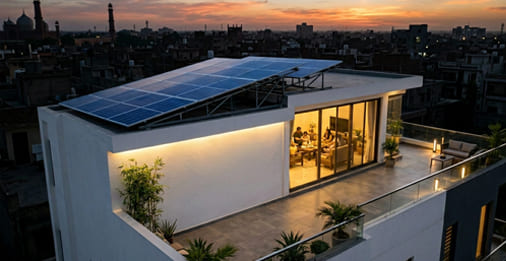
Pakistan has seen significant growth in solar adoption in recent years, driven by rising energy demand and widespread rooftop and distributed solar installations. For millions of Pakistanis in remote areas, agricultural zones, and locations where grid connection is either unavailable or unreliable, off-grid solar systems are not an alternative. They are the only viable solution. In this guide, we will discuss everything you need to know about off-grid solar systems in Pakistan, how they work, what they cost, who they suit, and how to make the investment confidently.
What Are Off-Grid Solar Systems?
Off-grid solar systems are solar power systems that work completely on their own without the need for grid support. They use solar panels to capture sunlight and convert it into electricity. This electricity is stored in batteries for use at any time, even at night. Unlike grid-tied systems, these solar systems are not connected to an electric grid. An off-grid system supplies all power from energy generated from the sun and stored in batteries. These solar systems are ideal for areas where grid access is limited or unreliable.
How Do Off-Grid Solar Systems Work?
Daytime Generation
Solar panels generate DC electricity throughout the day. A solar charge controller regulates the flow of that electricity into the battery bank, preventing overcharging and protecting battery life.
Battery Charging and Storage
The battery bank stores solar energy for use during periods when solar output is not sufficient. Battery capacity is the main factor that determines how many hours of autonomy the system provides when the sun is not generating power.
Power Delivery
The inverter converts the DC power into AC power. This AC power will be used to run household appliances. The inverter manages this conversion continuously and automatically.
System Management
A battery management system (BMS) monitors cell voltage, temperature, and charge state and protects against overcharge, deep discharge, and thermal issues that reduce battery lifespan.
What Are the Key Components of Off-Grid Solar Systems?
Solar panels
Solar panels, also called photovoltaic (PV) panels, are the central component of any solar power system. They capture sunlight and convert it into direct current (DC) electricity. In an off grid system, this electricity can be used immediately or stored in batteries for later use.
Charge controller
A charge controller regulates the voltage from your solar panels to charge your batteries safely. This device serves to prevent overcharging and safeguard your batteries from harm. Choose a charge controller that is rated for your system size.
Batteries
Off-grid systems require battery energy storage systems (BESS) as the primary storage solution. LiFePO4 lithium batteries are recommended for Pakistan’s climate conditions because they have high heat tolerance, 6,000 or more charge cycles, and zero maintenance requirements compared to lead-acid alternatives.
Off-Grid Inverter
An inverter converts the DC power from your batteries into AC power. This AC power will be used to run appliances and electronics in your house. Choose a pure sine wave inverter for sensitive loads like electronics for an off-grid system. The inverter size will depend on which devices you want to operate.
Backup Generator
Many advanced off-grid solar systems in Pakistan now also have a generator input port. When the weather is cloudy, and solar generation is not enough to recharge the battery, a generator provides supplementary charging without requiring a grid connection.
Off-Grid vs On-Grid vs Hybrid: Quick Comparison
Feature | Off Grid | On Grid | Hybrid |
Grid Connection | None | Yes | Yes |
Battery Required | Yes | No | Yes |
Works During Load Shedding | Yes | No | Yes |
Net Metering Eligible | No | Yes | Yes |
Best For | Remote areas | Urban areas with stable grid | Urban areas with load shedding |
Upfront Cost | Highest | Lowest | Medium |
Energy Independence | Complete | Partial | Partial |
For properties in urban areas with grid access, a hybrid system typically delivers better financial returns through net metering and lower battery requirements. For remote locations where grid connection is absent or unreliable, off-grid solar systems are the clear and practical choice.
Why Off-Grid Solar Systems Are Growing in Pakistan
The demand for off-grid solar systems is rising in Pakistan due to worsening energy conditions.
Load Shedding and Grid Instability
Power outages in both urban and rural areas are frequent. Grid dependence in these areas is unreliable.
Rising Electricity Costs
Many households are shifting toward solar independence as electricity tariffs continue to rise.
Rural Energy Access
In remote regions, grid infrastructure is weak or unavailable.
Who Should Choose an Off-Grid Solar System?
Remote and Rural Properties
Off-grid solar systems are most suitable for locations where connecting to the national grid is not feasible, where grid infrastructure is absent, or where the cost of extending grid connection exceeds the cost of a standalone solar system.
Agricultural land, farmhouses, remote residences, and rural villages across Punjab, Sindh, KPK, and Balochistan fall into this category. For these properties, off-grid solar systems eliminate the need for diesel generators entirely while delivering clean, silent, and cost-free power for 25 or more years.
Areas With Extreme Load Shedding
In parts of Pakistan where load shedding exceeds 16 to 20 hours per day, an on-grid or hybrid system loses most of its practical value. Off-grid solar systems operate with zero dependence on grid availability, making them effectively immune to load shedding regardless of how severe or unpredictable it becomes.
Businesses Needing Guaranteed Uptime
Cold storage facilities, food processing operations, medical clinics, and telecommunications infrastructure in remote areas cannot tolerate power interruptions. Off-grid solar systems sized for guaranteed uptime deliver the reliability these operations require without ongoing fuel costs.
Homeowners in Karachi and Beyond
For urban homeowners who want to explore off-grid options alongside other solar solutions, solar companies in Karachi can assess whether a full off-grid setup or a hybrid approach better suits your specific location, consumption, and budget.
What Are the Benefits of Going Off-Grid in Pakistan?
Environment Friendly
With off-grid solar systems, every appliance is powered by solar energy. With an average electricity supply mix, annual CO2 emissions for the energy you use at home would be around 3.2 tonnes per year. If you choose to be off-grid, your home can significantly reduce household carbon emissions.
No Load Shedding Impact
Off-grid solar systems operate entirely independently of the national grid. Load shedding, grid faults, and utility outages have zero impact on power availability for off-grid users. This is the defining advantage for Pakistani households and businesses in high load-shedding areas. The grid going down is simply irrelevant.
Freedom From Electricity Bills
Once an off grid solar system is installed and paid for, electricity costs drop to zero. With no ties to the national Grid, by generating your own solar energy, you are exempt from any energy price changes. With energy independence, you also gain complete budget stability, security, and comfort.
Long-Term Financial Return
Off-grid solar systems cost more upfront than on-grid equivalents due to battery requirements, but deliver significantly stronger long-term financial returns in locations with poor grid reliability by eliminating all electricity costs for the system’s full 25-year lifespan.
For homeowners concerned about upfront costs, solar panels on installments in Pakistan make off grid systems accessible without requiring full payment at the time of installation.
Cost of Off-Grid Solar Systems in Pakistan
Off-grid solar systems carry higher upfront costs than on-grid alternatives due to battery requirements. Here is a general cost reference for 2026:
System Size | Battery Capacity | Estimated Cost (PKR) | Daily Autonomy |
3 kW | 5 to 10 kWh | 700,000 to 1,100,000 | 6 to 10 hours |
5 kW | 10 to 15 kWh | 1,100,000 to 1,600,000 | 8 to 14 hours |
10 kW | 20 to 30 kWh | 2,000,000 to 3,000,000 | Full day coverage |
20 kW | 40 to 60 kWh | 3,800,000 to 5,500,000 | Industrial loads |
Installation and Maintenance
Professional Installation Is Essential
Off-grid solar systems carry more installation complexity than on-grid setups. Battery wiring, charge controller configuration, inverter programming, and system protection all require qualified technical expertise. Incorrect installation creates safety risks and significantly reduces system performance and battery lifespan.
What Maintenance Covers
Off grid solar systems require the most maintenance of all solar configurations due to the critical role of the battery bank. Regular battery health checks, panel cleaning, wiring inspections, and inverter monitoring are all necessary to maintain performance across the system’s full lifespan.
A structured operations and maintenance contract covers all of these requirements on a scheduled basis, ensuring faults are identified early, and the system continues delivering rated performance year after year.
Panel Cleaning in Pakistani Conditions
Pakistan’s dust, pollution, and seasonal weather accumulate rapidly on panel surfaces. Monthly solar panel cleaning is the minimum standard for most locations, with fortnightly cleaning recommended in high-dust industrial or desert environments. Efficiency losses from dirty panels can reach 20 to 30 percent without regular maintenance.
Conclusion
Off-grid solar systems represent the highest level of energy independence available to Pakistani homeowners and businesses. No grid dependency. No load shedding. No monthly electricity bill. For properties in remote areas, agricultural zones, and locations where the grid simply cannot be relied upon, off-grid solar systems are not a luxury. They are a necessity.
Here at Feroze Power, we design, supply, and maintain off-grid solar systems built for Pakistan’s specific conditions and demands. Get in touch today and find out what the right system looks like for your property.
Faqs
Q1. What are off-grid solar systems?
Off-grid solar systems are an energy solution that doesn’t depend on a traditional electricity grid. Unlike grid-tied systems, they are not connected to the grid and do not use it as a backup. These systems generate power from solar panels, store it in battery storage, and provide energy autonomy during outages.
Q2. Are off-grid solar systems suitable for urban homes in Pakistan?
They can be, but hybrid systems are usually more cost-effective for urban locations with access to a grid connection. They are more suitable for remote locations, places with extreme load shedding, or when a grid connection is unavailable or not reliable.
Q3. Can an off-grid solar system run a full house?
Yes, it can power an entire home if it is properly sized according to electricity usage. Battery capacity and solar panel output are designed based on daily energy consumption.
Q4. How much battery storage is needed for an off-grid system?
Battery capacity depends on how much energy you consume daily and how many hours of backup you need during low-solar periods. These calculations can be performed by a qualified installer who will determine the correct size according to your needs.
Q5. What is the payback period for off-grid solar in Pakistan?
The payback period for off-grid solar systems is usually between four and seven years, depending on the current generator fuel costs being replaced and the cost of grid connection that is being avoided. After payback, the system generates free power for its remaining operational life.