


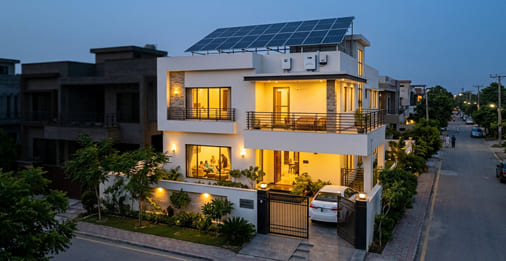
Pakistan’s electricity situation in 2026 has not improved for the majority of households and businesses. Karachi areas are reporting up to 10 hours of scheduled daily load shedding, with additional unplanned outages stacking on top. In lower-recovery rural areas, outages extending 8 to 12 hours per day are the norm rather than the exception. For families sitting in the heat and businesses losing production hours, the answer is no longer UPS systems or generators. The answer is hybrid solar systems.
Given Pakistan’s ongoing load shedding and rising electricity tariffs, a hybrid solar system offers the best value for residential and commercial customers in 2026. It delivers both backup security and long-term bill savings in a single investment. This guide covers everything you need to know before making that investment.
What Are Hybrid Solar Systems?
Hybrid solar systems combine solar panel generation, battery storage, and grid connection into a single integrated setup.
This system combines grid connection with battery backup using lithium-ion or tubular batteries. It is best for areas with frequent power outages. It provides backup during outages and maximizes self-consumption.
Unlike on-grid systems that shut down completely when the grid fails, hybrid solar systems switch to battery power automatically within milliseconds. Unlike off-grid systems that rely entirely on batteries, hybrid systems draw from the grid when needed, keeping battery costs manageable.
The result is a system that works in every condition, day, night, sunny, cloudy, grid up, or grid down.
Pakistan’s Load Shedding Reality in 2026
Load shedding in Pakistan in 2026 is not a seasonal inconvenience. It is a daily operational reality.
Urban areas face 4 to 10 hours of outages per day, while rural areas experience 10 to 20 hours, depending on their distribution company.
The national grid carries a surplus generation capacity of nearly 20,000 MW, yet the transmission and distribution infrastructure has not been able to deliver that power reliably to the homes and businesses that need it.
For homeowners, this means disrupted sleep, spoiled food, and hours without fans or air conditioning during Pakistan’s extreme summers. For businesses, it means lost production, damaged equipment, and the ongoing cost of diesel generation. Hybrid solar systems address all of these consequences simultaneously.
How Hybrid Solar Systems Work
Daytime Generation
Solar panels generate DC electricity throughout daylight hours. A hybrid inverter converts this into usable AC power for your home or business. Surplus generation charges the battery bank automatically.
During Load Shedding
A hybrid inverter automatically switches to battery power within milliseconds when the grid goes down. Your home continues running without any disruption. This is one of the key reasons hybrid systems have completely overtaken on-grid installations in 2026.
At Night
Once the grid is restored, hybrid solar systems draw from whichever source is most cost-effective: the charged battery bank or the grid, based on the settings configured in the system’s smart controller.
Exporting to the Grid
When solar generation exceeds both immediate consumption and battery capacity, surplus electricity flows back to the grid through net metering, earning credits against future consumption. This is what makes hybrid solar systems financially superior to off-grid setups for urban users.
What Are the Main Components of Hybrid Solar Systems?
Solar Panels
The panels are your primary generation source. Monocrystalline panels are the recommended choice for Pakistani conditions, offering the highest efficiency in intense heat and limited roof space. Choosing the best solar panels in Pakistan for your specific roof orientation and shading conditions directly impacts total system output.
Hybrid Inverter
A hybrid inverter combines solar, battery storage, and grid supply, keeping your home or business powered through every load-shedding hour, at night, and during grid faults. It supports net metering, too.
Inverter quality is the single most critical component decision in any hybrid solar system installation. Leading brands available in Pakistan include Growatt, GoodWe, Huawei, and Solis.
Battery Storage
If backup power during load shedding is a priority, a hybrid solar system with Battery Energy Storage Systems is the more appropriate solution.
Battery Energy Storage Systems (BESS) store surplus solar generation for use during outages and overnight periods. LiFePO4 lithium batteries are the recommended chemistry for Pakistani conditions, offering 6,000 or more charge cycles, excellent heat tolerance, and zero maintenance.
Mounting Structure and Wiring
Quality galvanized or aluminum mounting structures, correctly sized DC and AC cabling, and proper protection components are all essential to system safety and longevity. These are not areas to cut costs.
Hybrid vs On-Grid vs Off-Grid: Which Is Right for You?
Feature | On-Grid | Hybrid | Off-Grid |
Works During Load Shedding | No | Yes | Yes |
Battery Required | No | Yes | Yes |
Grid Connection | Yes | Yes | No |
Net Metering Eligible | Yes | Yes | No |
Upfront Cost | Lowest | Medium | Highest |
Best For | Zero load shedding areas | Most Pakistani homes and businesses | Remote areas without a grid |
For most Pakistani homes and businesses, a hybrid solar system is the better choice in 2026. Load shedding continues across Pakistan. An on-grid system without a battery shuts down completely during outages, which defeats the purpose for residential users.
What Are the Benefits of Hybrid Solar Systems?
Uninterrupted Power During Load Shedding
Hybrid solar systems eliminate disruptions from load shedding, store excess solar energy for nighttime use, reduce dependence on expensive grid power, and significantly lower monthly bills. Average monthly savings range from PKR 6,000 to PKR 12,000 with backup autonomy during outages of 4 to 8 or more hours.
Significant Bill Reduction
Hybrid solar systems consume self-generated solar power during the day, draw from stored battery power at night, and only pull from the grid when both sources are insufficient. For most Pakistani households, this reduces electricity bills at home by 70 to 90 percent within the first month of operation.
Net Metering Income
Under Pakistan’s current net billing framework, surplus energy exported to the grid earns credits against future consumption. While export rates have decreased under the 2025 Prosumer Regulations, self-consumption still delivers the strongest financial return, and hybrid solar systems maximize self-consumption by design.
No More Generator Costs
Diesel generators are expensive to run, noisy, and require ongoing fuel and maintenance. Hybrid solar systems eliminate generator dependency for most load-shedding scenarios, replacing recurring fuel costs with a one-time investment.
Long-Term Energy Independence
Solar reduces your bill significantly from day one. Hybrid and off-grid systems ensure uninterrupted power, keeping your home and business running during outages, and solar produces zero harmful emissions, reducing your carbon footprint.
Who Should Install a Hybrid Solar System?
Homeowners
For any home experiencing regular load shedding, hybrid solar systems are the most practical and financially sound solution available in 2026. Residential solar systems from Feroze Power are sized specifically for household consumption patterns, roof space, and battery backup requirements.
Businesses and Commercial Properties
Factories, offices, retail outlets, and commercial facilities lose revenue during every hour of load shedding. Commercial solutions using hybrid solar systems protect production continuity, eliminate generator fuel costs, and deliver payback periods of two to four years for most commercial applications.
Properties in High Load Shedding Areas
For Pakistani households experiencing frequent and extended outages, the case for hybrid solar systems is not an abstract energy policy discussion. It is a direct response to a daily quality of life problem that conventional solutions have failed to solve.
Properties that also want to explore wind generation as a complement to solar can consider pairing their system with wind turbines, particularly in coastal and elevated terrain areas of Sindh and Balochistan, where wind resources are strong year-round.
Cost and Payback in Pakistan
A complete 14 kW to 16 kW hybrid solar system with 16 kWh lithium battery, Tier-1 panels, and a named-brand inverter installed costs approximately PKR 2,700,000 to PKR 3,200,000 in 2026.
Here is a general cost reference for hybrid solar systems in Pakistan:
System Size | Battery Capacity | Estimated Cost (PKR) | Monthly Saving (PKR) |
5 kW | 5 to 10 kWh | 900,000 to 1,300,000 | 15,000 to 25,000 |
10 kW | 10 to 20 kWh | 1,600,000 to 2,200,000 | 30,000 to 50,000 |
15 kW | 15 to 30 kWh | 2,500,000 to 3,500,000 | 50,000 to 80,000 |
20 kW | 20 to 40 kWh | 3,200,000 to 4,500,000 | 70,000 to 110,000 |
Payback periods for well-sized hybrid solar systems typically fall between three and five years. After payback, the system continues generating savings for the remaining 20 or more years of its operational life.
For large-scale installations, working with a qualified EPC vendor ensures correct engineering, verified component procurement, and commissioning that meets NEPRA requirements for net metering approval.
Conclusion
Hybrid solar systems have moved beyond being an alternative energy option. In 2026, they will become a practical solution for Pakistani homes and businesses dealing with rising electricity costs and ongoing load shedding. By combining solar generation, battery storage, and grid support, these systems provide uninterrupted power, lower monthly bills, and greater energy independence. Feroze Power focuses on delivering solutions designed around Pakistan’s energy needs, helping homes and businesses adopt systems that support reliable and long-term performance.
Faqs
Q1. What are hybrid solar systems?
Hybrid solar systems combine solar panels, battery storage, and grid connection in a single setup. They generate power from solar during the day, store surplus in batteries, and automatically switch to battery power during load shedding without any interruption.
Q2. How long do hybrid solar systems last during load shedding?
Backup duration depends on battery capacity and the load being run. A 10 kWh battery powering essential household loads typically provides 6 to 10 hours of backup. Larger battery banks extend this to cover full overnight periods.
Q3. Are hybrid solar systems worth it in Pakistan?
Yes. With load shedding of 4 to 20 hours daily in most areas, rising tariffs, and falling battery prices, hybrid solar systems deliver both immediate quality of life improvement and strong long-term financial returns through bill reduction and net metering.
Q4. What size hybrid solar system do I need for my home?
Most medium-sized Pakistani homes require a 5 to 10 kW system with 10 to 20 kWh of battery storage. A professional site assessment and load analysis by a qualified installer determines the correct size for your specific consumption pattern.
Q5. How is a hybrid solar system different from an off-grid system?
A hybrid solar system maintains a grid connection for net metering and backup supply when batteries are depleted. An off-grid system operates entirely independently. Hybrid systems are more practical and cost-effective for most urban and semi-urban Pakistani locations.